
Social & Historical Context
Early on an autumn morning in the second year of the nineteenth century William Wordsworth stood upon Westminster Bridge and saw the mighty heart
of London:-
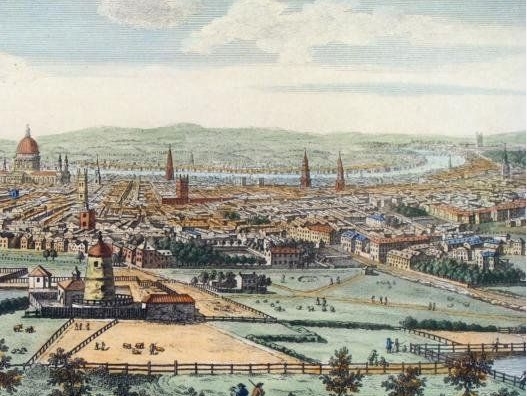
London from Richmond Hill, an engraving from a work by Giovanni Antonio Canal, ’Canaletto’
silent, bare,
Ships, towers, domes, theatres, and temples lie,
Open unto the fields, and to the sky;
All bright and glittering in the smokeless air.
Ships, towers, domes, theatres, and temples lie,
Open unto the fields, and to the sky;
All bright and glittering in the smokeless air.
In 1815 one third of England's population derived its living from work on the land and another third was engaged in occupations that supported the country dweller. In another fifteen years only a quarter of people were so employed. By the time of Wordsworth's death in 1850 London had taken in field after field and had more than doubled its population. The exodus of people from the country side to the major towns and cities that were rapidly expanding as a consequence the Industrial Revolution had impelled changes to society that were arguably only comparable to the Black Death in 1348-50.
The following century and a half covers a period of equal or even greater change; the latter part of Queen Victoria's reign and that of Edward VII saw Britain at the heart of near global hegemony, the map of the world dominated by the red of the British Empire. In juxtaposition to British imperialism abroad though, the average Englishman at home, if he were sensible and law-abiding, could pass through life and hardly notice the existence of the state, beyond the post office and the policeman, he could live where he liked and as he liked. Substantial householders might occasionally be called on for jury service, otherwise, at home, the state acted only to help those who could not help themselves and then only in the most rudimentary ways, it left the adult citizen alone.
The Great War heralded the beginning of the end of both the British Empire and the laissez faire domestic attitude of government at home. Out of necessity the state came increasingly to regulate the life of an Englishman and these controls were, for the most part, never relinquished. Indeed the Second World War, only a generation later, saw a further progression of government involvement. Scientific and technological advances, changes in the structure of society - these may be seen as the harbingers of the brave new world we inhabit today. So, in a landscape of exponential change, we come to today and these pages - such as they are; a few drops from the ocean of history. Their production, ironically enough, a function of change themselves.
Viewing the Past
Any view of history must tend, by nature, to be arbitrary and subjective. These small windows are no exception, the glass is old, tinted, vignetted, liable to distort to an extent whereby our subjects would find our fields of vision unrecognisable, A record of a person of whom there is no living memory, is two dimensional, merely an assemblage of dates, bald facts. Those things that make our own lives real and vivid are mostly neither visible, or audible; at best, barely discernible glimmers amongst the shadows of approaching twilight, whispers in the wind. The further back we try to peer the less there is to see, the dimmer the view, the louder the silence. The passing of each generation draws an impenetrable and permanent curtain across another window. Eventually it is bricked up altogether, rendered, plastered, painted - indistinguishable now from the surrounding masonry.
The People in These Pages...
Lived in the last half millennium and occupy one of four areas in the canvas of that landscape:-
Firstly there is the distant past, defined as the period from the Black Death to approximately the time of the English Civil War. Data is difficult, if not impossible to obtain, still less to verify. Information that does survive does so in spite the efforts of Henry VIII and Oliver Cromwell and their assaults on the institutions of their times, most civil records, however imperfectly taken and preserved were in the keeping of the Church. Even as recently as 1760 some parish records were compiled in Latin, inconsistently organised and compiled in hands that can be very hard to read.
The second band roughly covers the time between the end of the civil war in 1660 and a few years after the vision of William Wordsworth in September 1802. The available information that exists here is largely insufficient to allow
much more that dates and relationships, accordingly pages of this time will cover multitude of people grouped on one page e.g. The Coates Family of Suffolk
, The Parish Family of Essex
and so forth.
Thirdly we have the nineteenth century, only just beyond living memory in some cases, and in this period we are greatly assisted with better contemporary records, not least the introduction the CENSUS, material preserved within the wider family and other sources. Consequently pages covering this period are rather more comprehensive in scope and in many cases there exists sufficient detail for quite detailed presentation.
Lastly, the twentieth century. In contrast to the preceding periods the difficulty here is not so much one of discovering content to include, rather more at times deciding what to exclude! The rare and earnestly sought minutiae of 200 years ago become an embarrassing plethora so far as the here and now is concerned - there is no shortage of material, either at hand or relatively easy to obtain.
This then raises the question of the 'Terms of Reference' - what actually is the scope of this website? Should one resist the temptation, when faced with paucity of information, to go wide as well as deep? There are I find really no very clear-cut answers, other than:- I attempt to follow each of my parents direct forebears back as far as the facts permit. If in doing so for instance, I come across an interesting sibling, I may well include them, cf. John Herman Cousins. Moreover if along the way I discover something that I feel adds context and interest then this too may be ripe for inclusion.
How Many Ancestors?
It has been estimated that the chances of a baby born in 1947 not being related to Edward III (1312-1377), are of the order of 0.5%. Furthermore the chances are very high that everyone in the UK of British lineage is directly descended from the 2.5 million survivors of the Black Death in 1350. This, at first glance seems counter-intuitive, however consider this: Given that the maximum number of ancestors in a direct line is two per generation and if we express a generation as being 1 per 30 years, then over the 450 years 1947 - 1586 we have thirteen generations:-
| Generation | Year | Population – Estimated + 1.4% p.a. Adjusted. | Direct Ancestors of 'Self' at Generation # | Relationship to Self | Direct Descendants (*1.68%) of Generation #. (May also be expressed as number of cousins of 'Self' up to 13th) | Direct Ancestors as Proportion of Population % | Direct Descendants as Proportion of Population % |
|---|---|---|---|---|---|---|---|
| 1 | 1586 | 3,800,000 | *4096 | 10x Great Grand Parents | 6,881 | 0.107789474% | 0.18% |
| 2 | 1616 | 4,332,000 | 2048 | 9x Great Grand Parents | 11,561 | 0.047276085% | 0.27% |
| 3 | 1646 | 5,228,000 | 1024 | 8x Great Grand Parents | 19,422 | 0.019586840% | 0.37% |
| 4 | 1676 | 5,959,920 | 512 | 7x Great Grand Parents | 32,628 | 0.008590719% | 0.55% |
| 5 | 1706 | 6,794,309 | 256 | 6x Great Grand Parents | 54,816 | 0.003767859% | 0.81% |
| 6 | 1736 | 7,745,512 | 128 | 5x Great Grand Parents | 92,091 | 0.001652570% | 1.19% |
| 7 | 1766 | 8,829,884 | 64 | 4x Great Grand Parents | 154,712 | 0.000724811% | 1.75% |
| 8 | 1796 | 10,066,067 | 32 | 3x Great Grand Parents | 259,917 | 0.000317900% | 2.58% |
| 9 | 1826 | 11,475,317 | 16 | 2x Great Grand Parents | 436,660 | 0.000139430% | 3.81% |
| 10 | 1856 | 15,288,885 | 8 | 1x Great Grand Parents | 733,589 | 0.000052326% | 4.80% |
| 11 | 1886 | 27,231,229 | 4 | Grand Parents | 1,232,429 | 0.000014689% | 4.53% |
| 12 | 1916 | 35,230,225 | 2 | Parents | 2,070,481 | 0.000005677% | 5.88% |
| 13 | 1946 | 40,162,457 | 0 | Self | 3,478,409 | 0.000002490% | 8.66% |
| *2^12 |
Clearly the above is based on some unavoidably arbitrary assumptions. It cannot, for instance, take account of marriage between first cousins, neither is it possible to factor in the effects of immigration and emigration ( our distant relatives are likely to be scattered across the English speaking diaspora). Nonetheless, given these caveats, it is illustrative of the magnitudes involved.
The Arrogance of the Modern
The past is a foreign country: they do things differently there
- The Go Between, L P Hartley, 1953.
To what extent are our views of the past like that of the archetypal Englishman abroad? A 'Little Englander',boorish in behaviour, believing we do things better now, in the land of the present; that we are wiser, cleverer, somehow more enlightened than those less fortunate inhabitants of the past. Incontrovertibly we are indeed better off, in many obvious ways, than even our ancestors who lived on the historical near continent of only a hundred years ago, when my grandparents were young people. We are, for the most part, well-fed. Our health and social welfare is protected to an extent quite unimaginable to the most fortunate of that generation. The plethora of modern conveniences, from the motor car to the mobile phone, affect our perspectives to a degree whereby the past is a now very far away place indeed: diminishing in proportion to the exponential changes in the realm of today. We do, of course, have the advantage of knowledge, much of which is instantly accessible (and sometimes erroneous). Whether or not we are any wiser is quite another question entirely.
Understanding the foreignness of the past is a huge challenge, meeting that challenge offers the opportunity to see sometimes surprising alternatives to received values. In order to have any hope of understanding the people of the past we need to be aware of the social, cultural, intellectual, and emotional settings that shaped people’s lives and actions.
Today
To everyone who has encouraged, supported, patiently tolerated and shared parts of the way on this journey, thank you. By its nature this is a never-ending story, may it continue.....
Conventions
Women are primarily referenced by their married name.
Until it can be clearly demonstrated that this site can be adequately protected from open access, details of living people will be kept to the minimum that is commensurate with the protection of personal identity.
This is a private site, it is not meant for public dissemination. It is not visible to search engines and access is by invitation only. It is best viewed with Opens a new tab & navigates to an external websiteChrome. It will render in Internet Explores ( you may need to allow Activex Controls if prompted ) and Firefox; in both cases some functionality may not be visible. It will also work on Android devices, but is not optimised for these.
In order to use the Gallery Viewer Opens a new tab & navigates to an external websiteJavaScript must be enabled.